To Code or Not to Code?: A Cyberfeminist Workshop with Maisa Imamović
January 15, 7-10pm
Capacity for the workshop is 20 people. Please email us at us@joanlosangeles.org to sign up.
For more information on the related Book Launch & Conversation on January 16, see here.
The open-source traditions emerging from experimental computing communities historically encouraged developers and users to fork public code, modify it, and redistribute it in order to shape a diverse internet as it was becoming more present in daily life. Yet today’s prevailing user experience centers on supplying personal content to corporate platforms and cultivating the self. This shift began in the early 1980s, when Silicon Valley companies joined the open-source movement but gradually redirected it: as the tech industry grew more profitable, in-house developers were tasked with forking public code, removing authorship credits, and privatizing the results so they could be sold back to users as seamless “User Experience.”
As Eric S. Raymond notes in The Cathedral and the Bazaar, this period also marked the deterioration of the term hacker, increasingly cast as a threat rather than as a collaborative builder–an interpretation that continues to protect a corporate vision of the “average user.” At the same time, independent cyberfeminist interfaces were pushed to the bottom of dominant search engines. Despite the sharp contemporary divide between “developers” and “users,” corporate development practices remain structurally indebted to open-source methods. With the rise of AI tools, vibe-coding trends, and renewed reliance on corporate software templates, traces of hacker and cyberfeminist coding practices are increasingly obscured. This raises a central question: to code or not to code?
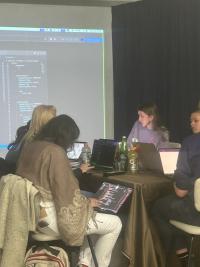
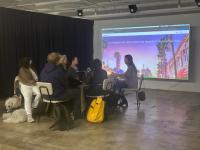
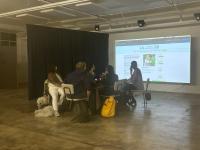
This workshop reexamines coding strategies through hacker and cyberfeminist frameworks, guiding participants to develop and publish deliberate replicas of institutional platforms–sites re-engineered to serve participants in various legal, political, and representational situations. These range from navigating immigration and cultural-validation processes, to reshaping public identity within celebrity-driven media environments, to critically responding to bureaucratic or judicial decisions.
Participants are asked to bring their own computer. Templates will be provided.
Outcomes include basic coding skills and the development of individual, published websites, using HTML/CSS, JavaScript, and preferred AI tools.
*This workshop is open to all levels of technical expertise, from beginner to advanced.
*
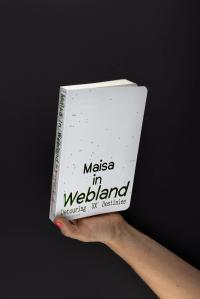
Maisa Imamović (BiH/NL, 1994) is a writer, web designer/developer, and experimental educator. She critically studies the role of the single user and user behaviors generated by code. Text + Code are her main mediums. Her first book entitled The Psychology of the Web Developer, Reality of a Female Freelancer was published by the Institute of Network Cultures in 2022. In 2024, she obtained her MA degree at the California Institute of the Arts and was kindly supported by Prins Bernhard CultuurFonds. In the academic year 2024-2025, she taught creative coding and the history of cyberfeminism as an adjunct professor at USC Media Arts + Practice, UCLA Design Media Arts, ArtCenter Interaction Design, and CalArts Integrated Media. She is pursuing a Ph.D. in Media Arts + Practice at the University of Southern California.